Bedding materials · Fibre guide
Wool in Bedding: How Its Natural Structure Shapes Comfort and Care
Soft but springy, warm without being simply heavy, wool has a character all its own in bedding. Its crimped fibres and the way they are layered, carded or gathered into fill influence everything from a pillow’s loft to the feel of a mattress topper. Understanding that structure makes it easier to choose, use and care for wool-filled sleep layers.
A fibre with a naturally springy shape
Wool is not a smooth, straight filament. Individual wool fibres have a fine, wavy form called crimp. Look closely at a loose fibre and those bends give it a gently rippled outline; gathered together, they help create a resilient, airy mass. The effect is familiar to anyone who has handled wool batting or a wool-filled pillow: it can compress under pressure and then recover some of its loft when that pressure eases.
That springiness is part of wool’s appeal in bedding, but it is only one piece of the story. Fibre length, fineness, preparation and the way the material is assembled all shape the finished feel. A tightly layered batt may feel more even and structured than loose tufts. A pillow filled with small pieces of wool may be more adaptable, while a continuous layer of wool inside a topper can feel comparatively uniform. “Wool bedding” is therefore a useful starting point, not a promise of one particular texture.
The word loft describes the height and fullness a bedding layer maintains. Crimp can help wool retain air between fibres, contributing to loft and a cushioned hand. Yet the amount of wool, the density of its assembly and the surrounding fabric matter just as much. A generously filled pillow may feel lofty at first; a compact, layered pillow can feel firmer even if both use similar fibre. Construction is the quiet detail behind the first impression.
Why wool feels different from other bedding fibres
Comfort is personal, and no fibre is ideal for every sleeper or every room. Wool is often chosen for its combination of pliability and substance. Compared with a very smooth, slick filling, its crimped structure can feel more textured and buoyant. Compared with a firm, solid core, loose wool fill can be more yielding and may be adjustable when the design allows it.
Wool is also valued for its interaction with moisture and temperature. Its fibre structure can take up some water vapour while still feeling comparatively dry to the touch, and the spaces between fibres can hold air. In bedding, those qualities contribute to wool’s reputation as a material that can feel comfortable across changing conditions. They do not mean that a wool pillow cannot become warm, or that it will suit everyone who sleeps hot. Room temperature, covers, mattress materials, personal preference and the amount of insulation in the whole bed all play a part.
That larger picture matters. A wool-filled layer sits among sheets, a duvet, a mattress and sometimes a protector or topper. Each layer influences how heat and moisture move through the bed. If a pillow feels too warm, changing its cover or the room’s bedding arrangement may be worth considering before assuming the filling alone is responsible. A breathable outer fabric can complement wool, while a dense or heavily layered setup may change the overall feel.
Wool should not be treated as a medical solution. A supportive pillow may feel more comfortable to one person than another, but materials alone cannot guarantee pain relief, posture correction or better sleep. Pillow height, firmness, sleeping position and mattress softness combine to affect how the head and neck rest. The best guide is a comfortable, well-fitting setup rather than a broad promise attached to any fibre.
From loose fill to layered batting
Wool appears in bedding in several forms, and the construction can be as important as the label. The most common distinction is between loose fill and batting. Loose fill is made up of fibres or small clusters that sit inside a casing. Depending on the design, it may move within the pillow and can sometimes be added to or removed to change the height. Batting, by contrast, is a prepared sheet or layer of fibre. It is often used in mattress pads, toppers or pillows built from stacked layers.
Layered batting usually offers a more consistent surface than a freely shifting fill. It can be quilted or tufted to help keep the layers in place, though the exact method varies. Over time, natural fibres may settle or compress with repeated use. How much that happens depends on the fibre preparation, construction, use and care. A settled appearance is not automatically a sign that an item is damaged, but persistent lumps or an altered shape can be a cue to check the manufacturer’s instructions.
Some pillows combine wool with another material. For example, a wool-wrapped latex design places a resilient latex core inside wool layers. In that arrangement, the core supplies much of the pillow’s structure, while the wool wrapping contributes a softer outer layer. It is not the same experience as a pillow filled entirely with wool. When comparing options, look beyond a short headline and check what makes up the core, what acts as the fill, whether the fill can be adjusted, and which parts can be cleaned.
For a practical illustration of wool as a sleep layer rather than a loose pillow filling, the Vispring Heaven Luxury Mattress Topper is described as a blend of cotton and British wool, at a height of 2.8 inches. That example highlights how wool can be incorporated into a topper’s construction, where the material is distributed across a broader surface. The product description identifies its composition; the experience of any topper will still depend on the mattress beneath it and the sleeper’s preferences.
Wool pillows: fill, shape and adjustment
A wool pillow can be built in several ways. Some have a fixed, stitched construction, while others use a zippered casing and removable fill. An adjustable design gives the owner a chance to change the pillow’s height and density by taking out or adding material. That flexibility can be useful because the right loft varies with body shape, sleep position and mattress firmness. A side sleeper may prefer more height than someone who mainly sleeps on their back, but there is no universal measurement that works for everyone.
When considering an adjustable wool pillow, make gradual changes. Remove a small amount, close the casing and try the pillow for a few nights before making another adjustment. Keep any removed fill clean and stored as directed, rather than discarding it immediately. It may be possible to restore a preferred level later, though the maker’s instructions should determine how the fill is handled and whether it can be redistributed.
Some designs use wool in a form described as wool puffs or bolus fill. These small clusters can be separated or rearranged to refresh the pillow’s shape, but that does not necessarily mean the wool itself is washable. The case and the fill may have entirely different care requirements. A zip is an invitation to access the interior, not an instruction to put every component in a washing machine.
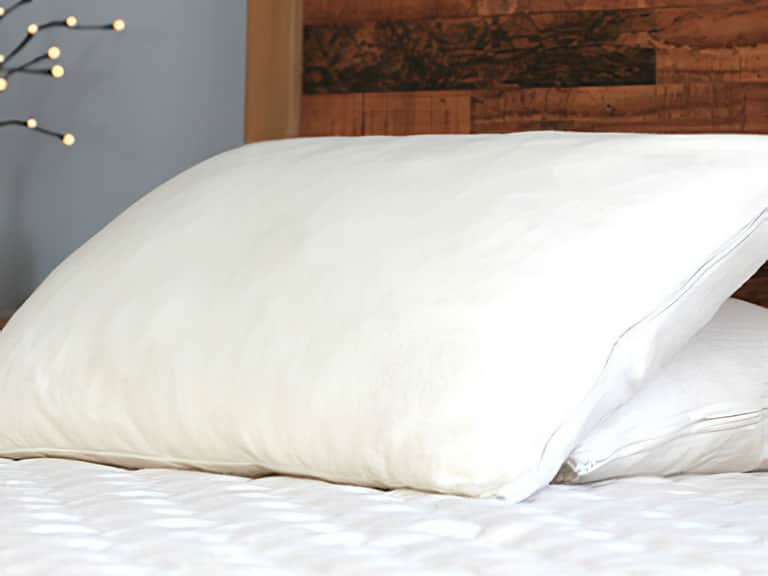
The Organic Wooly Down Bed Pillow is one example of an adjustable design with wool puff fill inside a zippered organic cotton case. Its care guidance distinguishes between the parts: the case can be washed after the wool puffs are removed, while the fill itself is not washable. That distinction is central to caring for many wool pillows. Always follow the care label for the particular construction rather than assuming that one product’s instructions apply to all wool bedding.
Firmness language can also be subjective. “Medium,” “soft” and “supportive” are useful signals, but they are not measured identically across every maker. A pillow’s feel depends on fill quantity, how firmly it is packed, the casing and the way the pillow compresses under your head. If possible, compare the listed dimensions and construction as well as the marketing description. A pillow that looks generous on a bed may compress to a lower profile once in use.
Care begins with the construction
Wool bedding is not one care category. Some products allow machine washing; others call for spot cleaning, airing or professional advice. Even two pillows made mostly from wool may have different rules because of their casings, stitching, internal layers or added materials. The safest first step is unglamorous but essential: read the care label and product instructions before cleaning.
Removable covers are often easier to maintain than the wool inside. A cover might be washable while the fill is not, or a pillow may have an outer casing and an inner liner with separate instructions. Check whether the cover can be removed without disturbing the filling, and note the permitted water temperature, cycle, detergent and drying method. Avoid improvising with bleach, fabric softener or high heat unless the maker explicitly allows it.
For a non-washable wool interior, prompt attention to small spills can help prevent a minor mark from becoming a larger cleaning challenge. Blot rather than rub, and use only methods permitted by the manufacturer. Saturating the filling may make it difficult to dry thoroughly and could affect the item’s shape. If a spill is substantial or the care directions are unclear, ask the maker or a qualified cleaner for guidance instead of guessing.
Air is part of routine care. Allowing a pillow or wool layer to air between uses can help it feel fresher and gives moisture an opportunity to disperse. Follow any guidance about sunlight: some items may be aired outdoors, while direct sun can be unsuitable for particular covers or fillings. A ventilated, dry place is generally a more cautious choice than leaving bedding in a damp room. Do not store wool bedding until it is fully dry.
Fluffing can help restore the shape of a pillow made with loose fill. Gently redistribute its contents rather than pulling aggressively at the casing or forcing compressed clusters apart. Layered wool batting should be handled with care, since pulling at a quilted surface may disturb the layers. A wool topper may benefit from the rotation or maintenance routine specified by its maker, but not every topper should be flipped. Check the product’s construction before changing how it sits on the mattress.
What to check before choosing wool bedding
A little label-reading can make the choice more straightforward. Start with what the item is designed to do: a pillow supports the head and neck, while a topper adds a separate layer across a mattress. Then look at the material breakdown and construction. A description that says “wool” may refer to the main fill, a wrap around a core, or one component in a blend. Those distinctions shape both the feel and the care routine.
- Fill or layer: Is the wool loose fill, small clusters, batting or a wrap around another core?
- Adjustability: Can the fill be removed or redistributed, or is the item a fixed shape?
- Cover: Is it removable, and does it have its own washing instructions?
- Dimensions and loft: Will the pillow height and size work with your sleep position and pillowcase?
- Care: Can any part be machine washed, or is spot cleaning and airing recommended?
- Composition: Are other fibres or materials included, and where are they used?
Consider your own preferences, too. Some people like the springy, gently textured character of wool; others would rather have a smoother or more uniform fill. Anyone sensitive to wool should pay attention to direct contact with the fibre and the details of the casing. A tightly woven cover may separate skin from the fill, but individual sensitivities vary, so it is sensible to evaluate the specific item and its materials.
Questions about animal welfare, fibre origin or environmental impact deserve precise answers rather than assumptions based on the word “natural.” Wool’s properties do not, by themselves, establish how it was sourced, processed or certified. If those considerations matter to you, look for clear information about origin and any relevant certification, and check what the certification covers. Natural fibre is a material description, not a complete account of a product’s supply chain.
A longer life for a natural fibre
Good care is less about elaborate rituals than a few consistent habits. Use a washable pillowcase or protector where appropriate, keep bedding dry, air wool layers when practical, and avoid washing a non-washable fill simply because the cover is due for laundering. For bedding with removable components, take them apart only as the care instructions permit. This simple separation of cover, filling and core can prevent a well-intentioned clean from causing avoidable wear.
It is also worth remembering that wool can change with use. A pillow may settle, and batting may become less lofty over time. Regular gentle reshaping may help some constructions, while others are designed to remain fixed. A change in feel is not always a defect: all bedding materials respond to pressure and repeated use. If the pillow no longer feels comfortable or a topper has developed an uneven surface, review the manufacturer’s care advice and consider whether the item has reached the end of its useful life.
Wool’s appeal lies in the meeting of fibre and craft. Its natural crimp gives it a springy structure; preparation and assembly turn that structure into a pillow, pad or topper with a particular feel. Once you know whether you are dealing with loose fill, batting or a wool-wrapped core, the choices become easier to understand. You can compare loft more thoughtfully, set realistic expectations about temperature and support, and care for each component according to what it actually is.
In the end, wool bedding is not a single sensation or a one-size-fits-all answer. It is a family of constructions made from a distinctive natural fibre. The best match is the one whose shape, materials and maintenance routine suit your bed and preferences. Read the label, pay attention to the layers, and let the structure—not just the name of the fibre—tell you what to expect.